
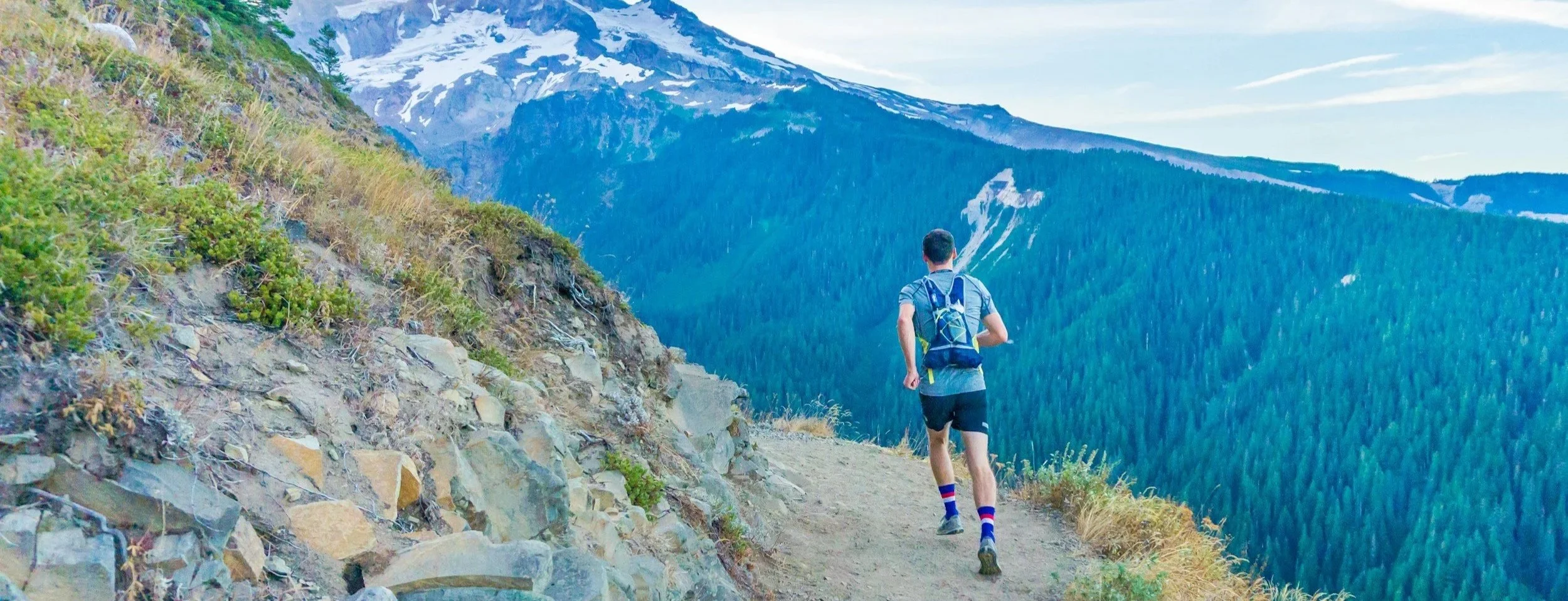
Running gear for explorative terrain.
The freedom to roam comes with the responsibility to be prepared. Water, food, layers, and the gear that lets you adapt to changing conditions all become part of the journey. Carrying them well means you spend less time thinking about what's on your back and more time immersed in the landscape.
Choosing the right pack or vest isn't about finding the biggest or lightest option. It's about finding the carry system that matches the experience you're after. Whether that's a quick morning loop close to home or a multi-day mountain objective.
THE MINDSET
There isn't a formula for choosing the right running pack. Some runners pack for what could go wrong. Others pack for what will make the day more enjoyable. Most of us fall somewhere in between.
The best place to start isn't with distance, it's with intention. Where are you going? What kind of experience are you looking for? What would allow you to move through the landscape with confidence and curiosity?
Whether that's carrying an extra layer for an unexpected storm, enough food to stay out a little longer, or simply the gear that lets you explore a route you've never seen before, the right pack is the one that supports the day you want to have.
THE TERRAIN
Maybe you're heading out on familiar trails just a few miles deeper. Maybe you're linking together ridgelines in a place you've never been before. The terrain you move through will influence how much you need to carry far more than the mileage itself.
A summer loop on your local trails may only require water and a few essentials. An all-day alpine objective, changing weather, or unfamiliar terrain often calls for additional layers, navigation tools, and emergency equipment.
The mountains ask different things of us every day, so pack accordingly.

THE GEAR
Once you know where you're going, deciding what to bring becomes much simpler. Every Yonder vest and pack is designed around 500ml soft flasks carried on the chest, keeping hydration close and accessible while you move.
Beyond water, think about what your route demands. Extra layers, nutrition, a shell, navigation, or technical equipment like a helmet, rope, GPS beacon, or ice axe all require additional space and a pack designed to carry them comfortably.
If you're exploring new terrain or pushing beyond your usual distance, it's worth carrying a little more than you think you'll need. Experience builds confidence, but preparation creates freedom.
TIME AND DISTANCE
Time and distance matter, but they rarely tell the whole story.
Ten miles on familiar singletrack can require less gear than five miles through technical alpine terrain. A short outing in unstable weather may demand more preparation than a long run on a clear summer morning.
Rather than asking how far you're running, ask what kind of day you're heading into.
When you know the terrain and have the right equipment with you, you're free to spend less time thinking about what's on your back and more time discovering what's around the next corner.
PACKS VS. VESTS
Our running vests are built for moving fast with only the essentials. They're streamlined for trail running, keeping hydration, nutrition, and layers secure without distracting from your stride.
Our running packs are designed for bigger objectives, where running naturally blends into scrambling, hiking, and alpine travel. They provide the capacity and stability needed to carry heavier loads, whether that's additional layers, climbing equipment, or technical gear without compromising runability.
Every Yonder carry system is built around the same principles: stability, comfort, and freedom of movement. The only difference is how far beyond the trailhead you're planning to wander.
KEY TAKEAWAYS
There’s no one-size-fits-all choice: The decision depends on terrain, required gear, and how long/far you’ll be out, rather than strict rules.
Terrain is the primary driver: More remote, technical, or harsh environments, like the high alpine or remote desert, demand more gear and water. Something like our packs are great options.
Gear needs determined pack size and type: Bigger capacity packs are better for carrying layers, technical equipment, or extra supplies, while our vests work well for lighter, faster runs.
When in doubt, carry more: Especially for unfamiliar or unsupported routes, extra capacity provides safety and flexibility.
Packs vs. vests serve different purposes: Our vests are optimized for speed and simplicity on trail runs, while our packs are optimized for mountain adventures where the objective may be longer, involve scrambling, and blur the line between running and mountaineering.